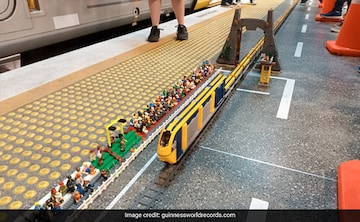
Image description: 14-year-old Alexander Blong of New Zealand now holds the World Record for most carriages in a Lego toy train, a 25-meter long, 101-carriage locomotive.
Who made the ultimate Master Builder – God? I have used the story of children discovering a train for the first time, as an illustration of cause, effect, and origins. In this illustration, the coach or railcar can be thought of as the effect and the engine can be thought of as the original cause. The engine causes all the other railcars to move. We are treating the train and railroad as a closed system, meaning we are only concerned with what is causing the motion of the train.
Two children, Lisa and her older brother Richard, had never seen a real train before. One day they entered the caboose of a very, very long train. On the back of the caboose a sign marked the car “Caboose.” Slowly, the train began to move and both children noticed that the caboose moved along with it. Lisa, curious as she was, asked her brother what pulled the caboose. Richard didn’t really know the answer, but of course he couldn’t tell her that, so he began to investigate. Soon enough, Richard found the coupler linking the caboose to another car. Fortunately, a sign marked the passenger car as a “Coach.”
“My dear little sister, this caboose is pulled by a coach.”
“Oh, really? I’m lucky to have such a smart brother.” Lisa followed her brave brother into the new railcar. “Richard, I have another question.”
“Yes?”
“What pulls the coach?”
Upon moving forward through the coach, Richard was able to spy another car. “Another coach.”
Needless to say, Lisa and Richard repeated this same round of question and answer for an exhausting amount of time. And though Richard began to tire of the whole process, Lisa’s curiosity pressed on.
“Good brother, do tell. Now, what pulls this coach?”
“Sister, sister, sister. Have you not already noticed that everything is pulled by a coach? Even this coach is surely pulled by another coach.”
At this point, the children had approached the front of the train and stood nearby the brakeman. “Are you sure of this?” The man surprised Richard.
“Why would I think this coach is pulled by anything else?” Richard asked, with his most confident voice. “Every other thing on this train is pulled by a coach.”
“And you are convinced of this by everything you have seen.”
“Yes.”
“And have you ever seen the engine?”
This stopped Richard for a flustering moment. “Engine?”
“I am the brakeman of this train. In front of us, the engineer drives the train’s engine. The engine pulls every other railcar on the train.”
“That’s not what I’ve seen. Every coach is the same. Each one is pulled by another.”
“You say this because you’ve never seen the engine. The engine is different from all the others, because it is the one that pulls all the others.”
At this point Lisa spoke up. “Brother, don’t you remember my book about train engines?”
A flash of recognition lit up his face, and he laughed in relief. “Oh, of course! My sister has a children’s book about talking train engines. Well, I’m sorry to have to spoil it for everyone, but it turns out train engines are fairytales and nothing more.”
Our train story has ended, and now it is time to find the moral.
If you are a sharp listener, you might have noticed that the coaches or railcars are like everything in this world that we have already seen. We can see very much, and it is natural for us to ask where it all came from. Someone might tell you that one thing came from another. This is partially true. Take for example a Lego. Either a person at a factory made the Lego, or a robotic machine put the Lego together. But the very curious child would like to know who put the robot together. Either a robot or a person. So who made the person? Two parents made the person. Who made the parents? And so the questions go on like a long train full of railcars.
If we were to go on long enough, we would run into something called origins. That means how everything got its start. Like the engine on a train, this one thing has set everything else in motion. It’s hard to imagine something that wasn’t made by anything else, because everything we’ve already seen is made by something else. Now let’s say God is like the train’s engine. In our closed system, the engine has no maker. The passengers don’t get to see the engine when they’re riding, so one could walk from one end of the train up to the brakeman and not see the engine. We’re like passengers on planet Earth. We can see everything else, figure out how it’s made, but we can’t see the original Maker, God. Remember that the engine was different from every other railcar because it pulls all the other cars without being pulled. Nothing comes before that engine. And you could say, God is different because He made everything else without Himself being made. Nothing comes before Him, which is why He is preexistent. So who made God? Nobody – is the answer that makes sense when you consider the options.
Another option is to disbelieve the train engine. Or to say that everything had a cause, so that our universe came from another universe (an unseen universe at that). That universe had to come from another universe and so on. However, without a train engine there is instead an infinite length of railcars pulled by no engine. Or there is a railcar at the front of the train pulled along by nothing. Or God was made by another God was made by another God… and so on for an infinite train of engines. Which of the trains make the most sense? Endless railcars, railcars pulled by nothing, or railcars pulled by an engine? Although the engine might be the only one of its kind in a very long train, it is necessarily an original cause of the train’s motion.
The good news is, someday we will get to see the Master Builder. There are two ways we can join Him in Heaven. The first way is to be perfect. If you’re human like me, you’ve already ruined that chance. The other way to go is to accept His free gift. God gave His perfect Son Jesus to take our place. When we accept this perfect gift, we become brand new and ready for a perfect place. Someday I’ll be there, and I’ll have a whole set of questions to ask God. I know His answers will be the best.

 godbrix